In short
- Deep past: hunter-gatherers have lived here for tens of thousands of years; the engravings at Twyfelfontein are a UNESCO World Heritage site.
- 1884–1915: German South West Africa. Between 1904 and 1908 German forces carried out the genocide of the Ovaherero and Nama, in which tens of thousands died.
- 1915–1990: South African rule, under a League of Nations mandate from 1920 and illegally after 1966, with apartheid imposed.
- Liberation: SWAPO began an armed struggle on 26 August 1966; UN-supervised elections in 1989 led to independence on 21 March 1990.
- Today: a stable democracy still working through the legacy of land dispossession. Since 2025, 28 May is Genocide Remembrance Day.
First peoples
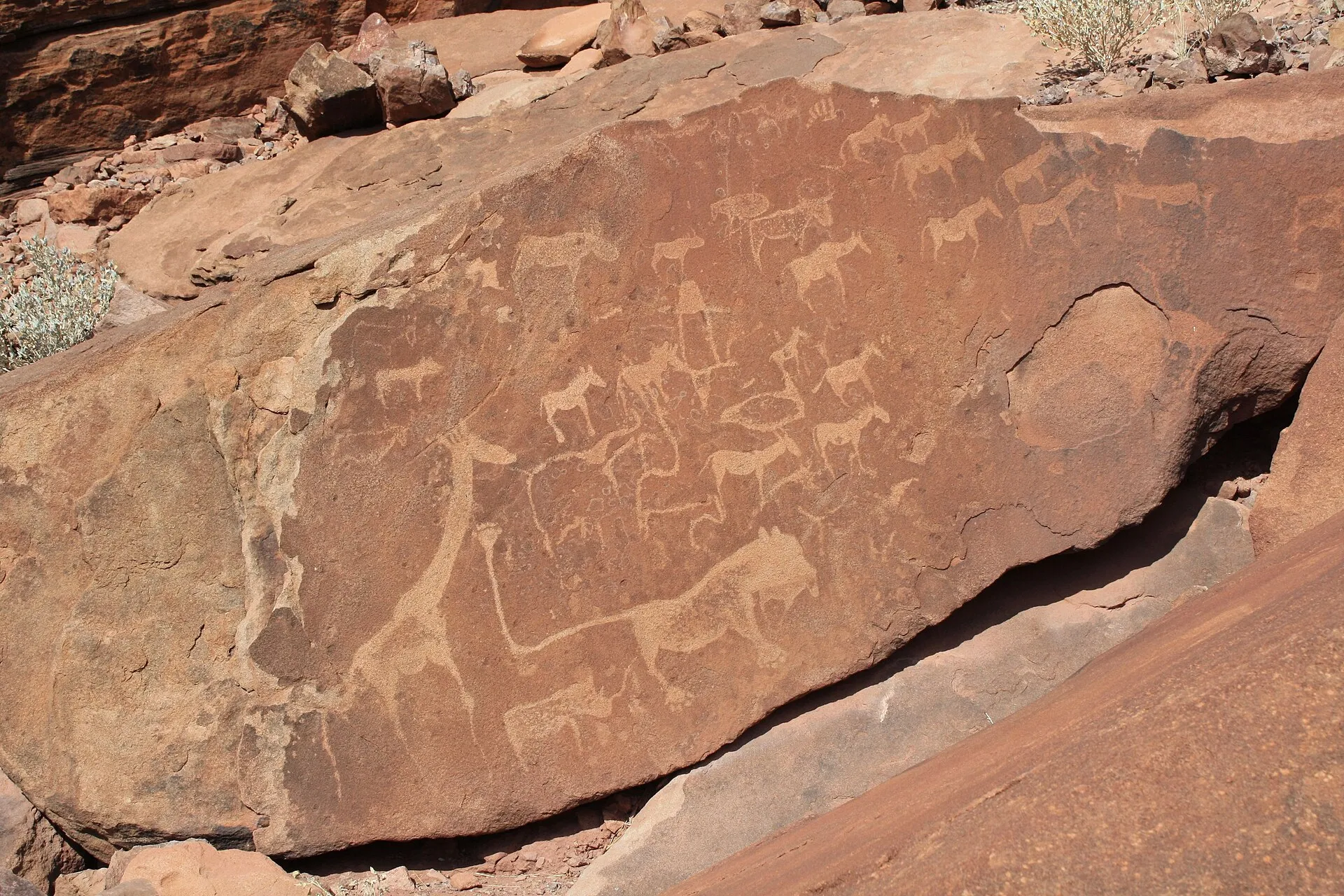
People have lived in what is now Namibia for a very long time. Painted stone slabs from the Apollo 11 Cave in the Huns Mountains of the far south, depicting animals in charcoal and ochre, are dated to more than 25,000 years ago and are among the oldest figurative art in Africa. The later rock art of hunter-gatherer communities, ancestors of today’s San, survives at thousands of sites: more than 2,000 engravings on the sandstone of Twyfelfontein (ǀUi-ǁAis), inscribed as a World Heritage site in 2007, and the paintings of the Brandberg and the Erongo, mostly made within the last 6,000 years.
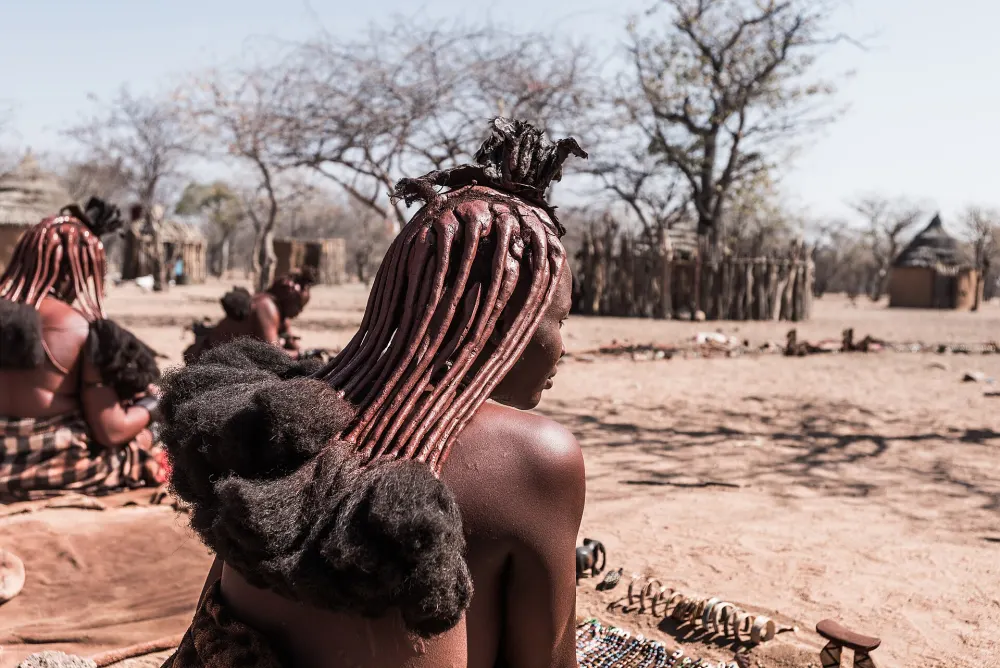
About two thousand years ago herders with sheep, and later cattle, moved into the region; the Nama and Damara speak Khoekhoegowab, a language of this Khoe tradition. From roughly the fourteenth to the seventeenth centuries Bantu-speaking farmers and cattle-keepers arrived from the north and east: the ancestors of the Aawambo and Kavango peoples settled the better-watered north, and the Ovaherero moved with their herds through Kaokoland into the central grasslands.
Sailors, traders and missionaries
The desert coast kept Europeans out for centuries. The Portuguese navigator Diogo Cão raised a stone cross at Cape Cross in 1486, and Bartolomeu Dias anchored at what is now Lüderitz on his way round the Cape the following year, but neither found a reason to stay. Whalers and guano collectors worked the coast in the eighteenth and nineteenth centuries.
The interior changed in the early 1800s, when Oorlam groups — Khoe-speaking people from the Cape Colony with horses and guns — crossed the Orange River. Under Jonker Afrikaner they established themselves at Windhoek by about 1840 and dominated central Namibia for a generation, raiding and trading in rivalry with Herero chiefs. Missionaries of the Rhenish (German) and later Finnish societies followed, along with traders in cattle, ivory and firearms. Britain annexed the harbour of Walvis Bay in 1878 on behalf of the Cape Colony, and left the rest.
German South West Africa, 1884–1915
In 1883 the Bremen merchant Adolf Lüderitz bought the bay of Angra Pequena and the surrounding coast from the Nama leader Josef Frederiks in a deal that turned on a deliberately ambiguous definition of a “mile”. In 1884 Bismarck placed the area under German protection, and at the Berlin Conference the European powers recognised the claim. German South West Africa was the only German colony considered suitable for large-scale white settlement.
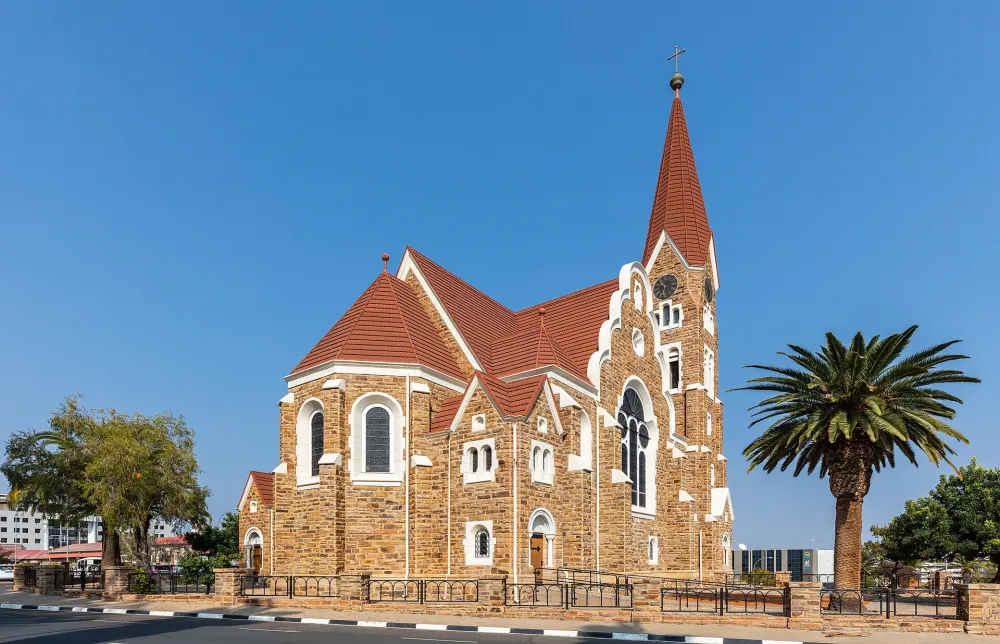
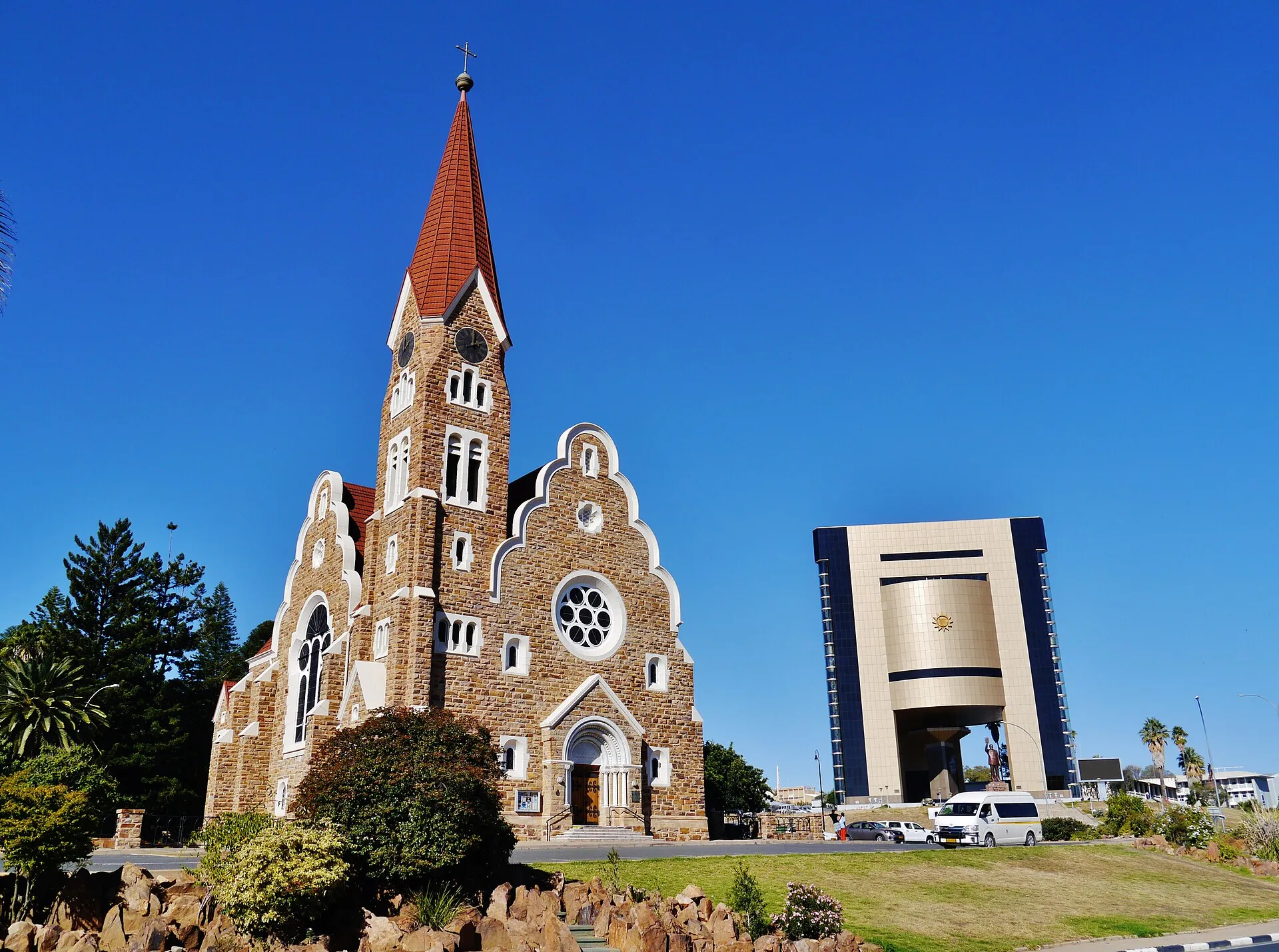
Colonial rule spread through “protection treaties”, military force and the transfer of land and cattle to settlers. The rinderpest epidemic of 1897 killed most Herero cattle and drove many people into debt and wage labour. A railway was built from Swakopmund to Windhoek; the forts and churches that visitors photograph today — the Alte Feste and Christuskirche in Windhoek, the buildings of Swakopmund and Lüderitz — date from these decades.
The genocide of the Ovaherero and Nama, 1904–1908
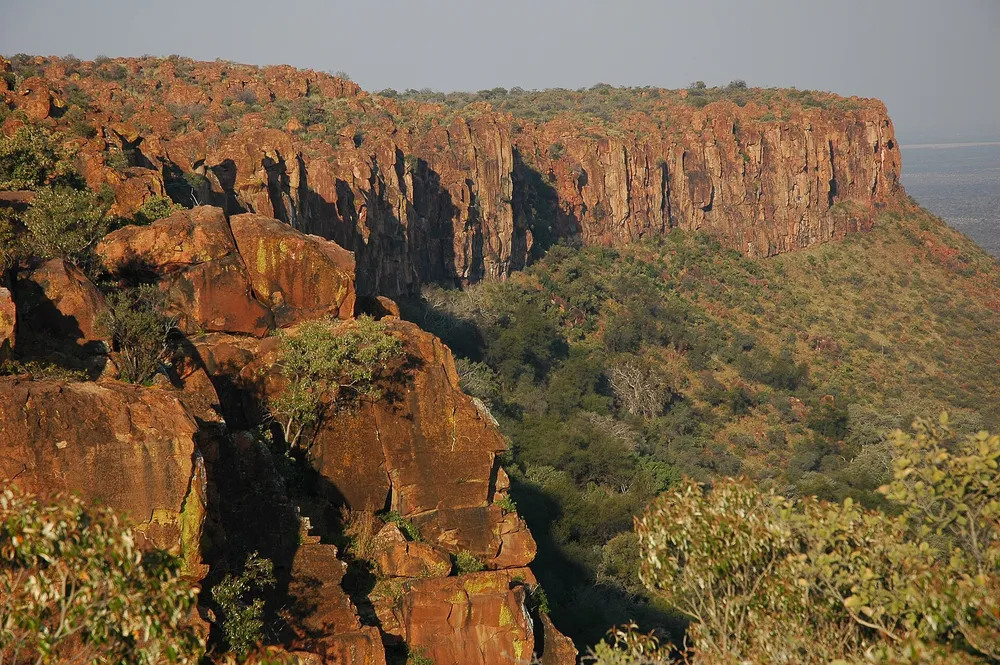
In January 1904 the Ovaherero under Samuel Maharero rose against the loss of their land and the abuses of settlers and traders. After early Herero successes, Germany sent reinforcements under Lieutenant-General Lothar von Trotha. At the battle of Ohamakari, below the Waterberg, on 11 August 1904, the Herero were defeated and fled east into the waterless Omaheke sandveld. German troops sealed off the waterholes behind them.
On 2 October 1904 von Trotha issued what is known as the extermination order, declaring that every Herero found within German territory, armed or unarmed, would be shot, and that women and children would be driven back into the desert. That same month the Nama of the south rose under Hendrik Witbooi, then in his seventies, and fought a guerrilla war for years; in April 1905 von Trotha issued a similar proclamation against them.
Survivors of both peoples were held in concentration camps — the German term Konzentrationslager was used — at Windhoek, Swakopmund, Okahandja, Lüderitz and elsewhere, and put to forced labour. Conditions on Shark Island at Lüderitz were so lethal that most prisoners sent there died. The camps were closed in 1908. Historians estimate that some 65,000 of about 80,000 Ovaherero and at least 10,000 of about 20,000 Nama died. The survivors’ remaining land and cattle were confiscated. It is widely regarded as the first genocide of the twentieth century.
Germany formally acknowledged these events as genocide in a joint declaration negotiated with the Namibian government and announced in May 2021, with a pledge of €1.1 billion in development funding over thirty years. Many Herero and Nama representatives rejected the agreement because they were not party to the negotiations and because it avoids the word “reparations”, and it has remained contested. In 2025 Namibia marked 28 May — chosen as the anniversary of the German order to close the camps — as Genocide Remembrance Day, a national public holiday, for the first time.
Diamonds and the end of German rule
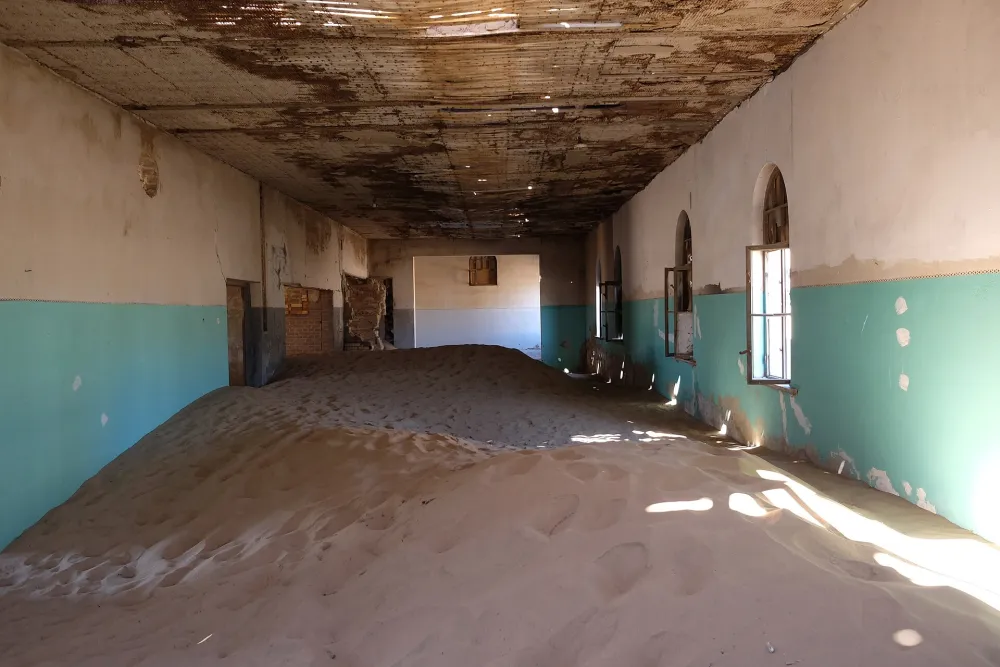
In April 1908 a railway worker, Zacharias Lewala, picked up a diamond in the sand near Kolmanskop and handed it to his supervisor, August Stauch. The rush that followed made Lüderitz briefly one of the richest towns in Africa, and the colonial government closed a vast stretch of the southern Namib as the Sperrgebiet, the “forbidden zone”, to control it. The ghost town of Kolmanskop, abandoned in the 1950s, is what remains.
German rule ended with the First World War. South African forces invaded in 1914–15 on Britain’s behalf, and the German colonial troops surrendered at Khorab, near Otavi, on 9 July 1915.
South African rule and apartheid, 1915–1966
In 1920 the League of Nations entrusted South West Africa to South Africa as a mandate, to be governed in the interests of its inhabitants. In practice it was run as a fifth province. More land was given to white settlers, many of them poor Afrikaners; Africans were confined to reserves and controlled by pass laws and a contract-labour system that sent Ovambo men south to mines, farms and fish factories for a year or more at a time.
After 1945 South Africa refused to place the territory under United Nations trusteeship, and from 1948 apartheid legislation was applied there. On 10 December 1959 police fired on residents of Windhoek’s Old Location who were protesting their forced removal to the new township of Katutura, killing eleven or more; the date is now Human Rights Day. In the 1960s the Odendaal Commission’s plan divided the country into ethnic “homelands” — Ovamboland, Kavangoland, Hereroland, Damaraland, Namaland and others — whose names still linger on maps.
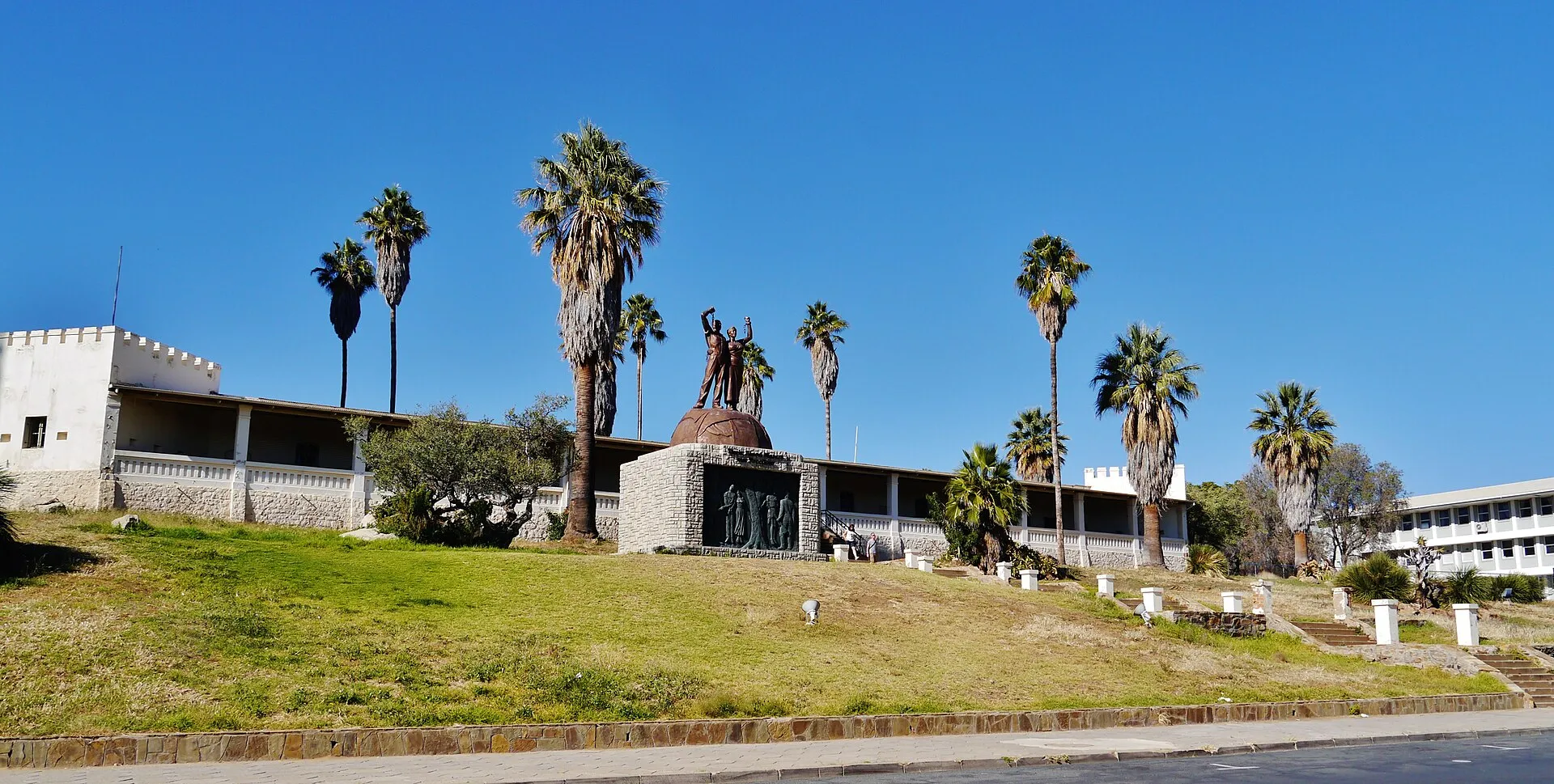
The Alte Feste in Windhoek, built as a German fort in 1890 and later a museum.
The liberation struggle, 1966–1989
Organised resistance grew out of the contract workers’ movement. The South West Africa People’s Organisation, SWAPO, was founded in 1960 with Sam Nujoma as president and petitioned the UN for independence. In 1966 the UN General Assembly revoked South Africa’s mandate; on 26 August that year the first clash between SWAPO guerrillas and South African forces took place at Omugulugwombashe in the north — now commemorated as Heroes’ Day. In 1971 the International Court of Justice confirmed that South Africa’s presence was illegal.
The war that followed was fought mainly in the far north and, after Angola’s independence in 1975, from bases across the border, entangled with the Angolan civil war and the Cold War. On 4 May 1978 South African forces attacked a SWAPO camp at Cassinga in southern Angola, killing some 600 people, many of them civilians — Cassinga Day. That same year UN Security Council Resolution 435 set out a plan for elections and independence, which South Africa stalled for a decade.
A military stalemate in southern Angola in 1987–88 and the waning of the Cold War finally produced an agreement, signed in New York in December 1988, linking Namibian independence to the withdrawal of Cuban troops from Angola. A UN transition force oversaw elections in November 1989. SWAPO won 57 % of the vote, and a constituent assembly drafted a constitution that is still admired for its protection of rights.
Independence and after
Independent Namibia chose reconciliation over retribution: no property was seized, and the white minority stayed. The price of that peace is that the distribution of land still largely follows colonial lines, with a few thousand commercial farms covering much of the centre and south, and land reform under a “willing buyer, willing seller” policy has moved slowly. Unemployment, especially among the young, is high, and the discovery of large offshore oil fields in the Orange Basin since 2022 has raised both hopes and questions. Through it all the country has held regular elections, changed presidents peacefully and kept its courts and press independent.
- 21 March 1990
Independence
Namibia becomes independent, with Sam Nujoma as its first president.
- 1 March 1994
Walvis Bay returns
South Africa hands over the Walvis Bay enclave and the offshore islands, which it had retained in 1990.
- 1996
Conservancy legislation
Communities on communal land gain the right to manage and benefit from wildlife, the basis of today’s conservancies.
- 2005
First transfer of power
Hifikepunye Pohamba succeeds Nujoma; Hage Geingob follows in 2015.
- 2013
Renamed regions
The Caprivi Region becomes the Zambezi Region; Kavango is split into Kavango East and West; Lüderitz constituency is renamed ǃNamiǂNûs.
- 2021
Joint declaration with Germany
Germany acknowledges the genocide of 1904–08; the accompanying agreement remains disputed in Namibia.
- 4 February 2024
Death of President Geingob
Vice-president Nangolo Mbumba completes the term.
- 8 February 2025
Death of Sam Nujoma
The founding president dies aged 95.
- 21 March 2025
First woman president
Netumbo Nandi-Ndaitwah is inaugurated on the 35th anniversary of independence.
- 28 May 2025
Genocide Remembrance Day
Observed for the first time as a national public holiday.
Seeing history on the road
- Windhoek: the Independence Memorial Museum, Alte Feste, Christuskirche, Heroes’ Acre and a guided visit to Katutura. See Windhoek.
- Twyfelfontein and the Brandberg: rock engravings and paintings, with local guides. See Damaraland.
- The Waterberg: the 1904 battlefield, cemetery and memorials. See Waterberg and the central plateau.
- Swakopmund and Lüderitz: German-era townscapes, museums, and the memorials to the camps. See Swakopmund and Lüderitz and Kolmanskop.
- Cape Cross: replicas of Diogo Cão’s cross beside the seal colony. See the Skeleton Coast.
- Okahandja: the graves of Herero leaders, visited in the annual commemoration each August.
The peoples whose history this is are introduced in culture.
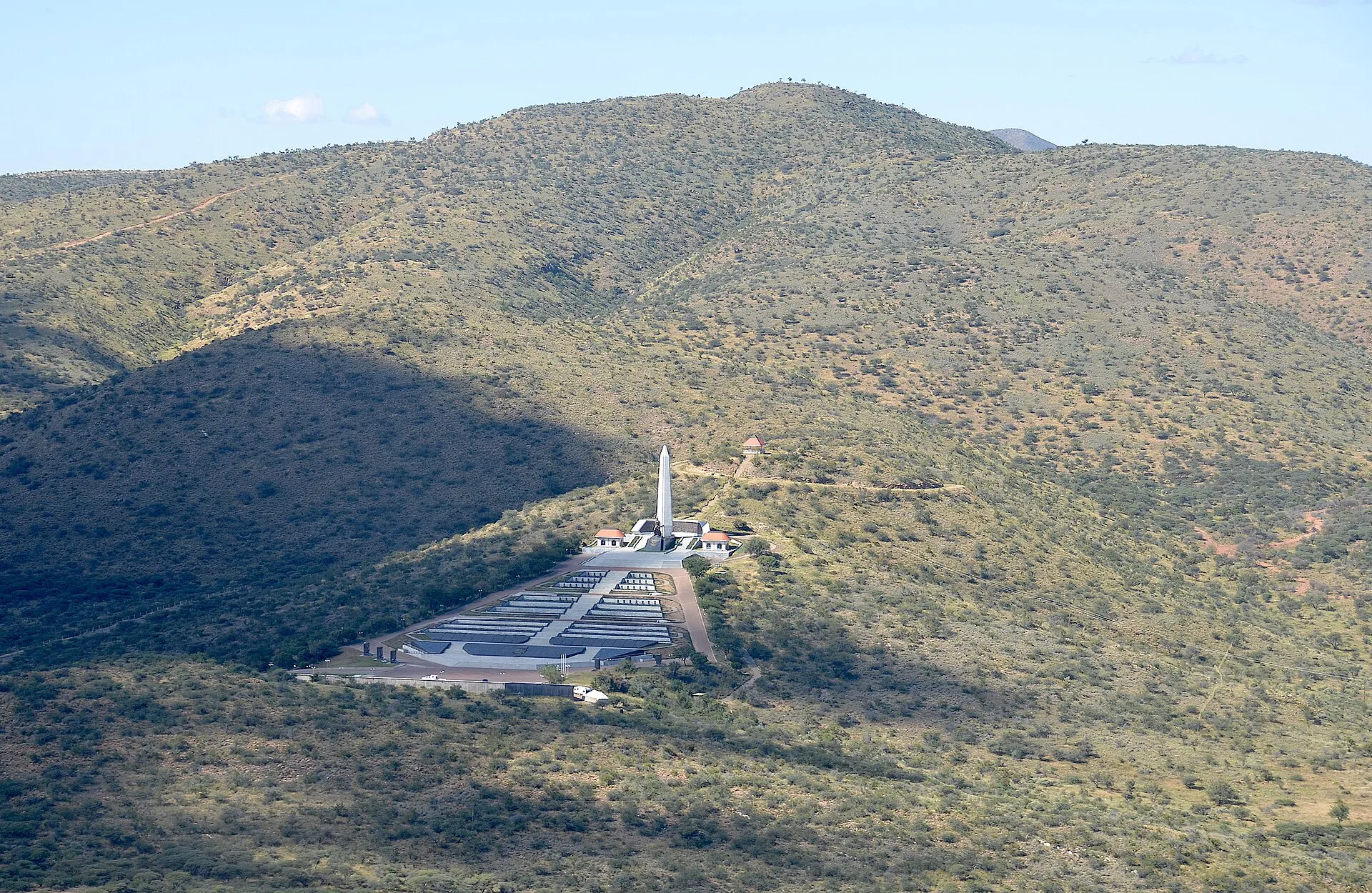
Heroes’ Acre, the national memorial to the liberation struggle, in the hills south of Windhoek.
Frequently asked questions
When did Namibia become independent?
On 21 March 1990, after UN-supervised elections in November 1989. It had been ruled by South Africa since 1915 and by Germany from 1884 to 1915.
What was the Herero and Nama genocide?
Between 1904 and 1908 German colonial forces crushed uprisings by the Ovaherero and Nama, drove survivors into the desert, issued extermination orders and held prisoners in concentration camps. An estimated 65,000 Ovaherero and at least 10,000 Nama died. Germany acknowledged it as genocide in 2021.
Why is German spoken in Namibia?
Namibia was the German colony of South West Africa from 1884 to 1915, and some settlers’ descendants remained. A small German-speaking community still lives mainly in Windhoek, Swakopmund and on farms, and German-era architecture survives in several towns.
What was Namibia called before independence?
South West Africa — German South West Africa (Deutsch-Südwestafrika) until 1915, then South West Africa under South African administration. The name Namibia, from the Namib Desert, was adopted by the UN in 1968.
Who is the president of Namibia?
Netumbo Nandi-Ndaitwah, inaugurated on 21 March 2025 as the country’s fifth president and the first woman in the office.
Sources and official information
Facts were checked against these official sources in November 2026. Park fees, gate times, visa rules and timetables change, so confirm before you go.
NamibiaSafaris.com is an independent guide, not the official site of any tour operator, lodge, Namibia Wildlife Resorts or the Namibian government. Some links are affiliate links: tours go to GetYourGuide and accommodation goes to Booking.com, and we may earn a commission at no extra cost to you.