In short
- Biggest risk: road accidents, above all single-vehicle rollovers on gravel and collisions with animals at night. Keep to 80 km/h on gravel and do not drive after dark.
- Malaria: high risk all year in the Kavango and Zambezi regions; high from December to April and low from May to November in the northern regions that include Etosha, Kunene and Otjozondjupa; very low in Windhoek, the coast, the Namib and the south.
- Vaccines: UK guidance lists hepatitis A, tetanus and typhoid for most travellers. A yellow fever certificate is required only if you arrive from, or transit for more than 12 hours in, a risk country.
- Heat and sun: carry 5 litres of water per person in the vehicle, and plan desert walks for the first hours after sunrise.
- Emergencies: police 10111; in Windhoek the city ambulance and fire service is on 061 211 111. Take insurance that includes medical evacuation by air.
A realistic picture
Namibia is politically stable, thinly populated and well organised, and most visitors meet nothing worse than a puncture and a sunburnt neck. It is also a country where the nearest hospital can be four hours away on gravel, where midday temperatures in the desert exceed 40 °C in summer, and where the animals are not behind fences. Safety here is mostly a matter of distance and preparation.
This page summarises the guidance of the UK’s National Travel Health Network and Centre (TravelHealthPro), the US Centers for Disease Control and Prevention (CDC) and the UK Foreign, Commonwealth and Development Office, as checked on 21 November 2026. It is not medical advice. See a travel clinic or your doctor six to eight weeks before departure, particularly if you are pregnant, travelling with young children, or have a medical condition.
Malaria: where and when
Malaria in Namibia is confined to the north and is strongly seasonal, following the rains. The parasite is almost entirely Plasmodium falciparum, the dangerous form.
| Area | Risk | What official guidance recommends |
|---|---|---|
| Kavango East, Kavango West and Zambezi regions (Rundu, Divundu, Bwabwata, Mudumu, Katima Mulilo) | High all year | Antimalarial tablets plus bite avoidance |
| Kunene, Omusati, Oshana, Ohangwena, Oshikoto, Otjozondjupa and Omaheke regions — includes Etosha, Kaokoland, Opuwo, Epupa, Tsumeb, Grootfontein, the Waterberg, Khaudum | High from December to April; low from May to November | TravelHealthPro: tablets in the high-risk months, bite avoidance in the low-risk months. The CDC recommends tablets for these regions without a seasonal distinction |
| Rest of Namibia — Windhoek, Swakopmund, Walvis Bay, the Skeleton Coast south of the Kunene Region, Sossusvlei and the Namib, the Kalahari, Fish River Canyon, Lüderitz | Very low | Bite avoidance only; the CDC states there is no transmission in Windhoek |
Preventing malaria
The antimalarials recommended for Namibia’s risk areas are atovaquone/proguanil, doxycycline and mefloquine (the CDC also lists tafenoquine); chloroquine is not effective. Each has a different schedule — atovaquone/proguanil is started one to two days before entering the risk area and continued for seven days after leaving, doxycycline for four weeks after — and different side effects, so the choice is one for you and a prescriber.
Whatever you take, avoid being bitten. The mosquitoes that carry malaria bite between dusk and dawn:
- wear long sleeves, long trousers and socks in the evening;
- use a repellent containing DEET at 50 %, or icaridin, on exposed skin;
- sleep under a net or in a screened, air-conditioned room; most lodges in the north provide nets;
- keep the tent zipped from late afternoon.
Any fever during the trip or for up to a year afterwards should be treated as possible malaria: see a doctor promptly and say where you have been.
Vaccinations and entry rules
- Routine vaccines should be up to date, including measles (MMR) and diphtheria-tetanus-polio. Namibia has reported circulating vaccine-derived poliovirus, and both the UK and US agencies advise a booster for some travellers.
- Usually advised: hepatitis A, tetanus and typhoid.
- Sometimes advised: hepatitis B; rabies, for long stays, remote travel, work with animals and — a Namibian peculiarity — for coastal water sports, because rabies has been confirmed in Cape fur seals; cholera, for travellers to areas with active outbreaks (the CDC named parts of Kunene and Otjozondjupa in November 2026).
- Yellow fever: there is no risk in Namibia. A certificate is required of travellers aged nine months or over arriving from a country with risk of transmission, including those who have spent more than 12 hours in transit in such a country.
Entry documents are covered in the visa guide.
Sun, heat and dehydration
Most of Namibia lies between 1,000 and 1,700 m above sea level under a cloudless sky, and the ultraviolet index is extreme for much of the year. Add dry air that evaporates sweat before you notice it, and dehydration arrives quietly.
- Drink before you are thirsty: 3–4 litres a day in summer, more if you walk. Keep 5 litres per person in the vehicle at all times as an emergency reserve.
- Wear a wide-brimmed hat, sunglasses and high-factor sunscreen; cover your arms and neck on dune walks.
- At Sossusvlei, in the Fish River Canyon and in Damaraland, walk early. From October to March be off the sand by mid-morning. A short desert walk begun at midday with a single bottle of water is how heatstroke happens.
- Recognise heat exhaustion: headache, nausea, dizziness, cramps. Stop, get into shade, cool the skin with water, drink with rehydration salts. Confusion or a failure to sweat is heatstroke — a medical emergency.
- Winter nights are the opposite problem. At or below freezing in June to August, an unprepared camper can be dangerously cold; see the packing list.
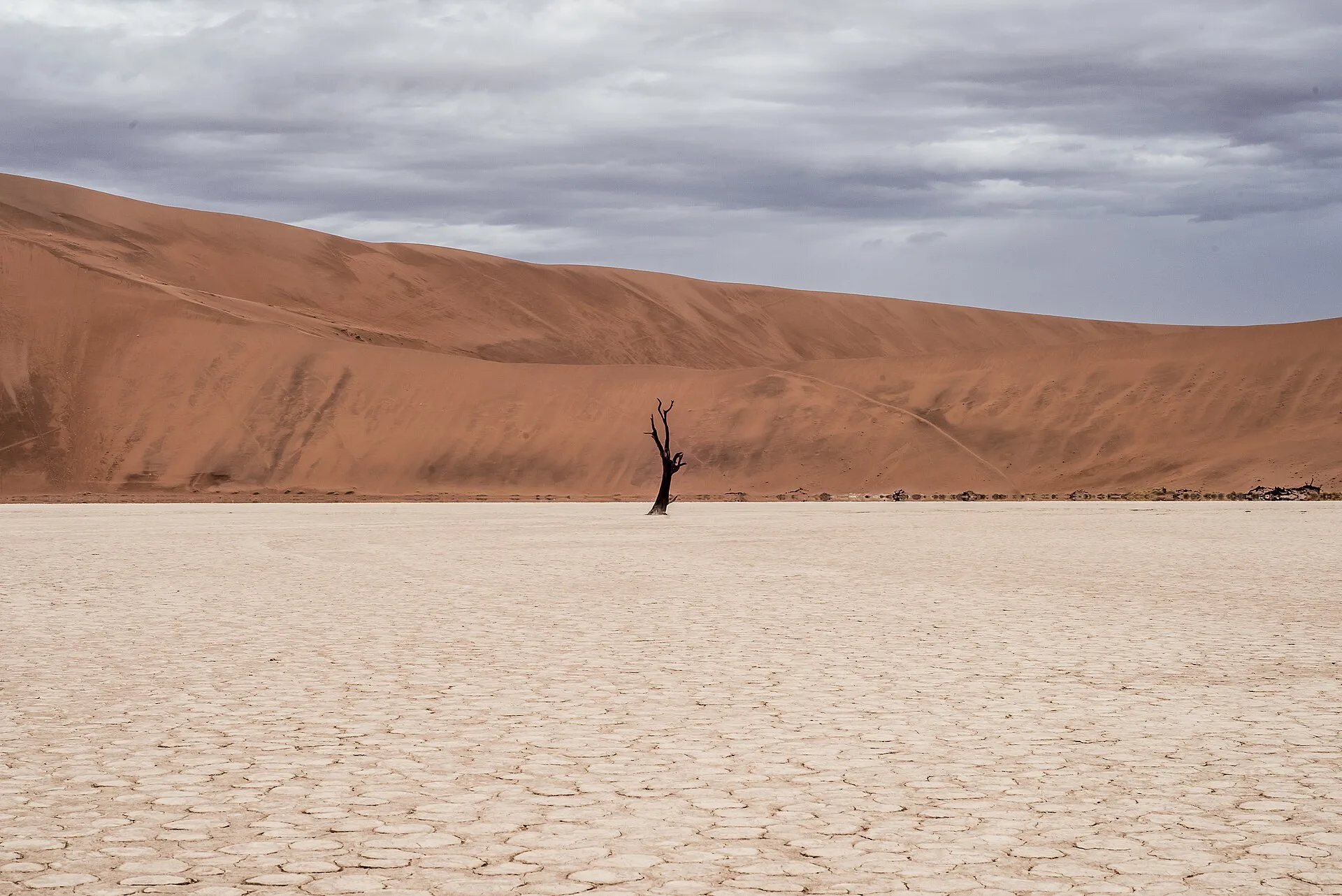
No shade and no water: desert walks belong to the first hours of the day.
Road safety: the main risk
Road crashes injure far more visitors than disease, crime and wildlife combined; the CDC notes that motor-vehicle crashes are the leading cause of death among healthy travellers abroad. Namibia’s specific hazards are loose gravel, long monotonous straights, tyre failures, and animals.
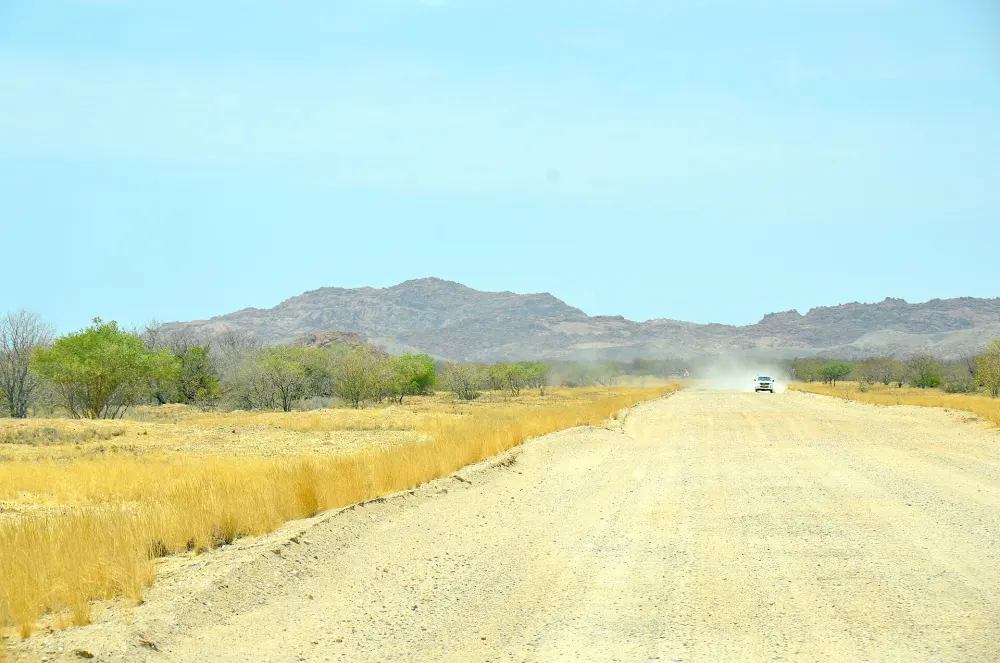
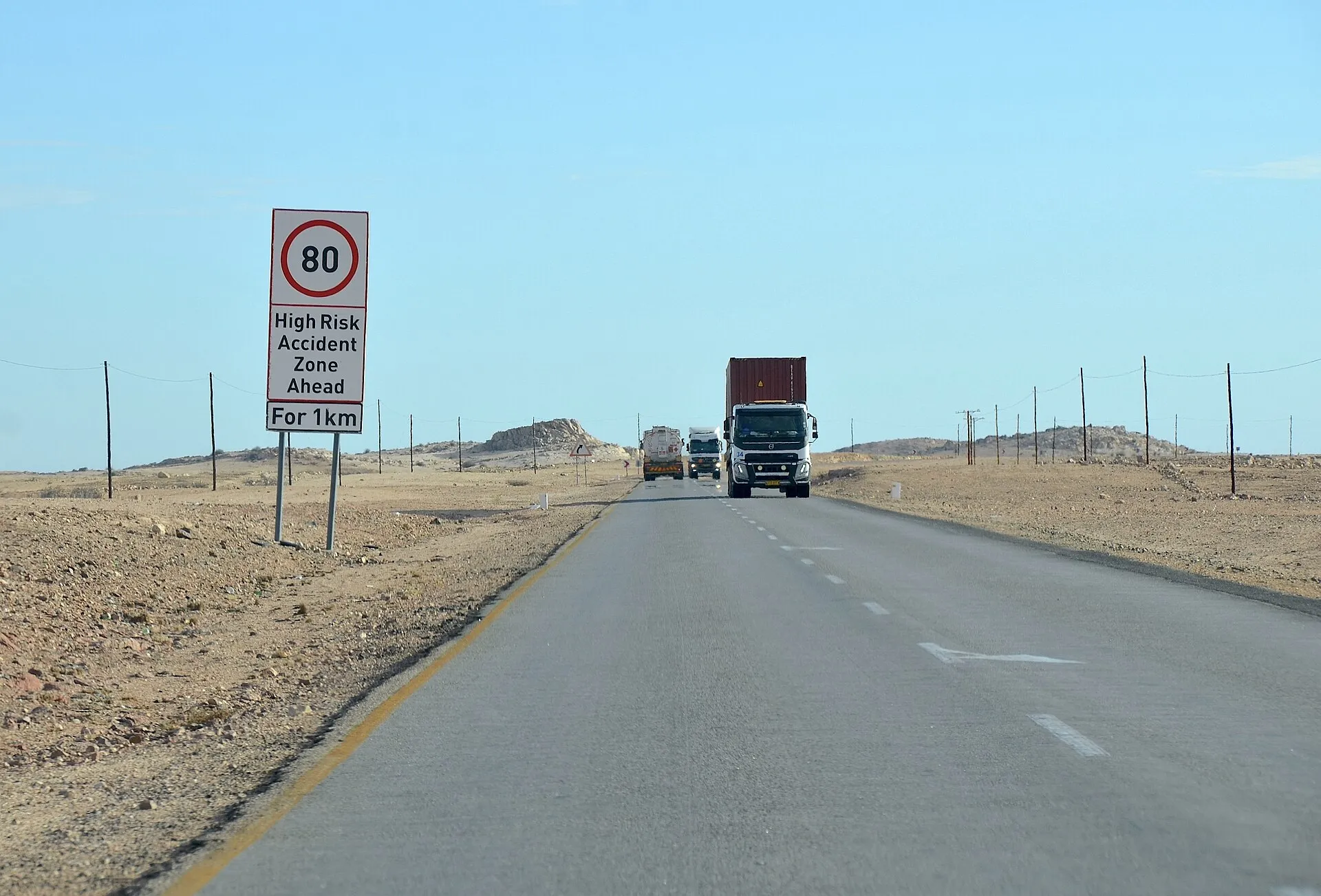
- Gravel: stay at or below 80 km/h, slower on bends and rough surfaces.
- Night: do not drive outside towns after dark. Kudu, warthog and livestock on the road cause severe collisions.
- Fatigue: limit yourself to five hours at the wheel, share the driving and stop every two hours.
- Seat belts: every seat, every time; in a rollover they are the difference.
- Tyres: check pressures and condition daily, carry two spares on remote routes.
- Overtaking on tar: trucks on the B1 and B2 are long and slow; wait for a clear view.
The technique is set out in the self-drive guide. If you are not confident on gravel, a guided safari removes the largest risk of the trip.
Wildlife: in parks and in camp
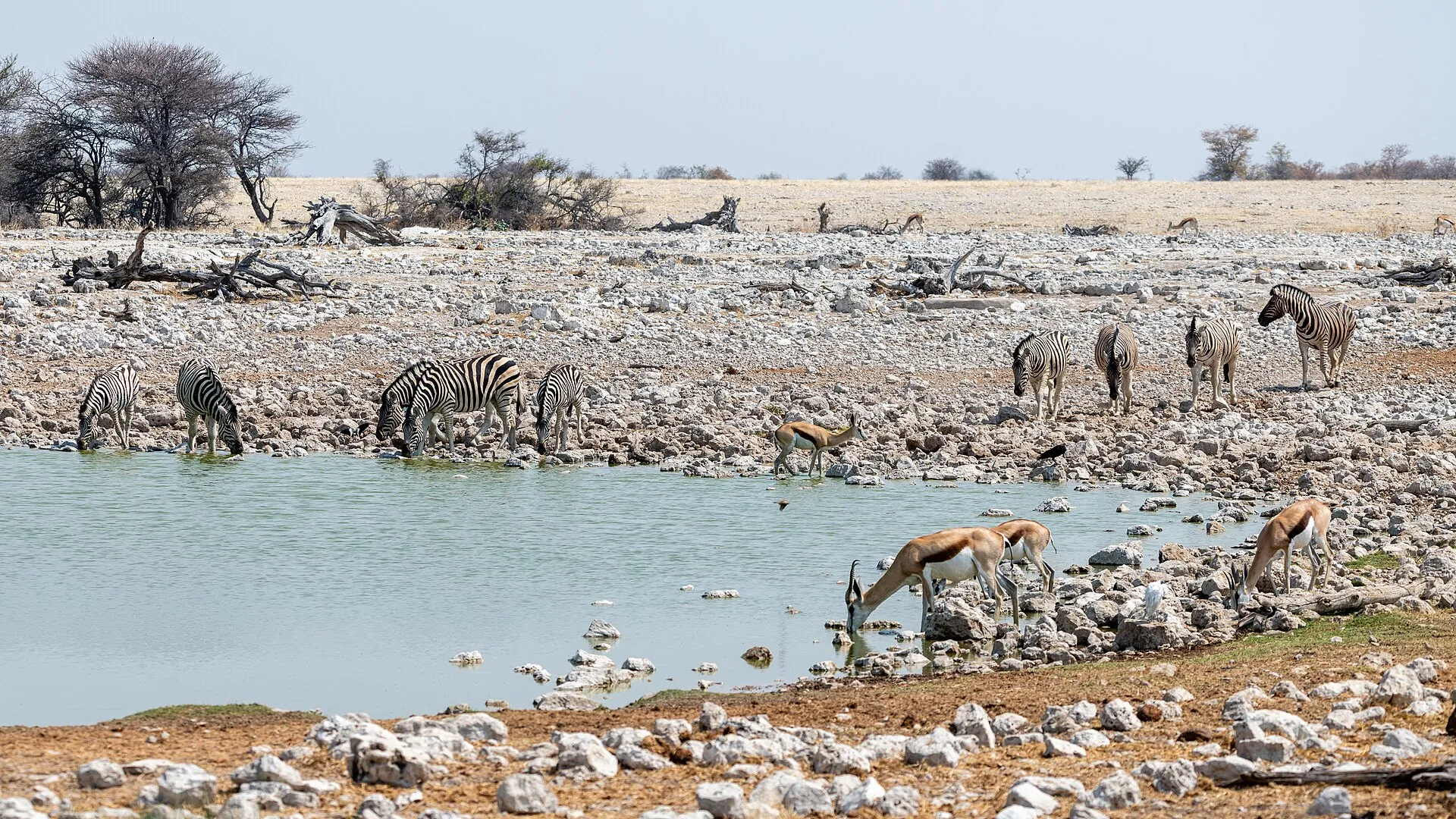
- In national parks stay in the vehicle except at fenced camps, signed picnic sites and toilets. Lions rest in the shade of roadside bushes and are invisible until you are beside them.
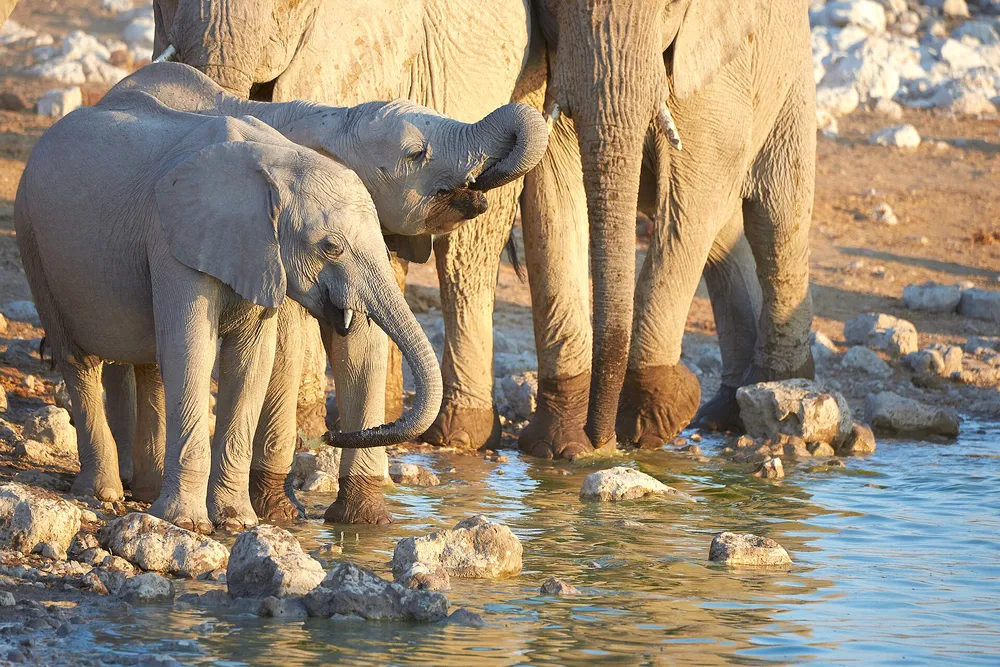
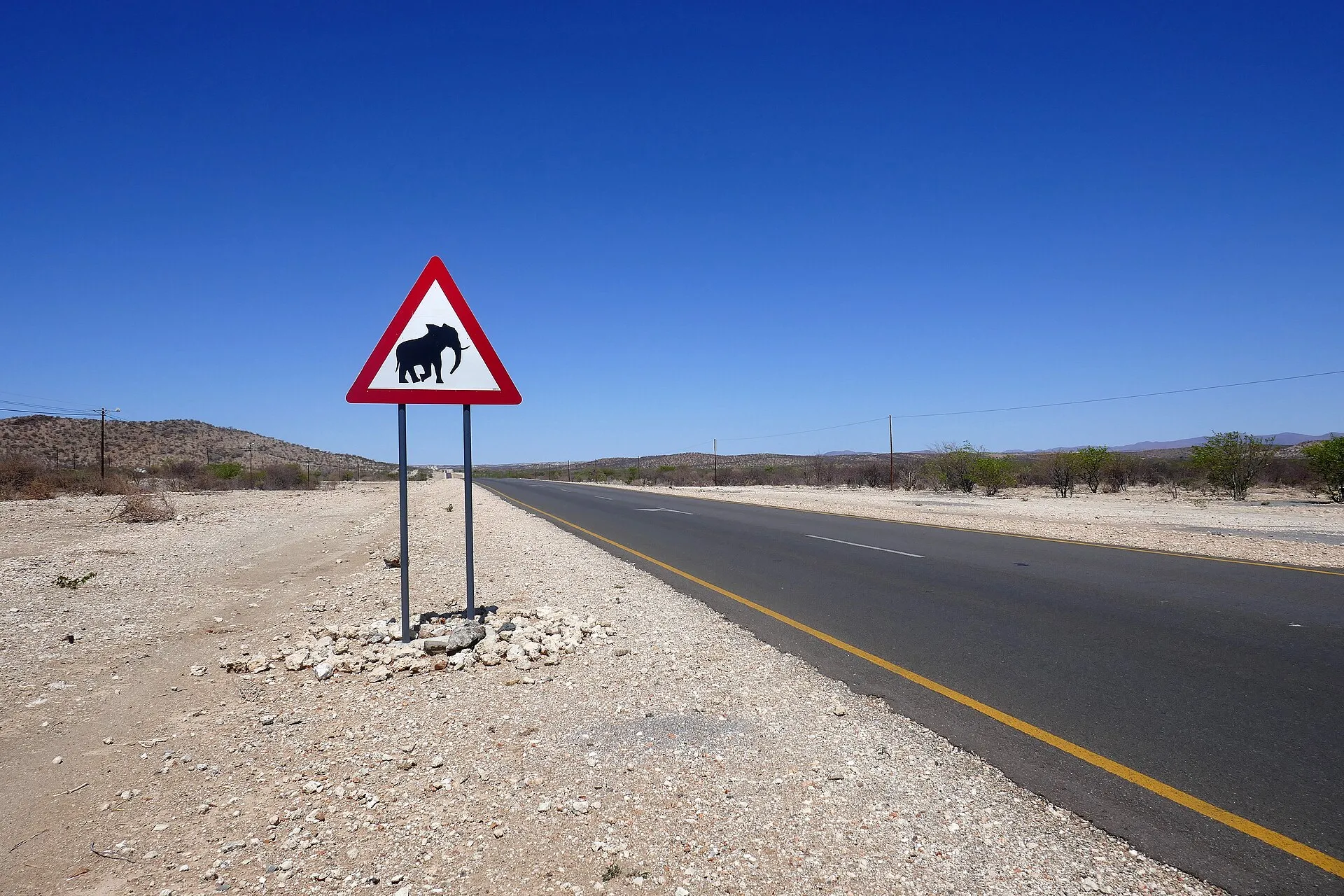
- Give elephants room. Stop well back, switch off the engine, never get between a cow and a calf, and reverse away if one flaps its ears, shakes its head or walks towards you. Desert-adapted elephants in Damaraland’s riverbeds are wild and unfenced; go with a local guide and do not camp in riverbeds.
- Unfenced camps are common outside Etosha. After dark use a torch, walk only on the paths, and let staff escort you if they offer. Keep food locked in the vehicle: jackals, honey badgers, hyenas and baboons raid camps.
- Rivers of the north — the Kunene, Okavango, Kwando, Chobe and Zambezi — hold crocodiles and hippos. Do not swim, wade or stand at the water’s edge, and do not walk between a hippo and the river at night. Fresh water in these rivers can also carry schistosomiasis (bilharzia).
- Seals bite, and rabies has been confirmed in Cape fur seals on this coast. Keep your distance at Cape Cross and Pelican Point, follow your kayak guide’s instructions, and seek urgent medical assessment after any bite or scratch from any mammal.
- Snakes and scorpions are present and rarely seen. Wear closed shoes at night, shake out boots in the morning, do not put hands into rock crevices or under logs, and use a torch. A bite or sting is a reason to go to a clinic, calmly and promptly.
Crime and personal security
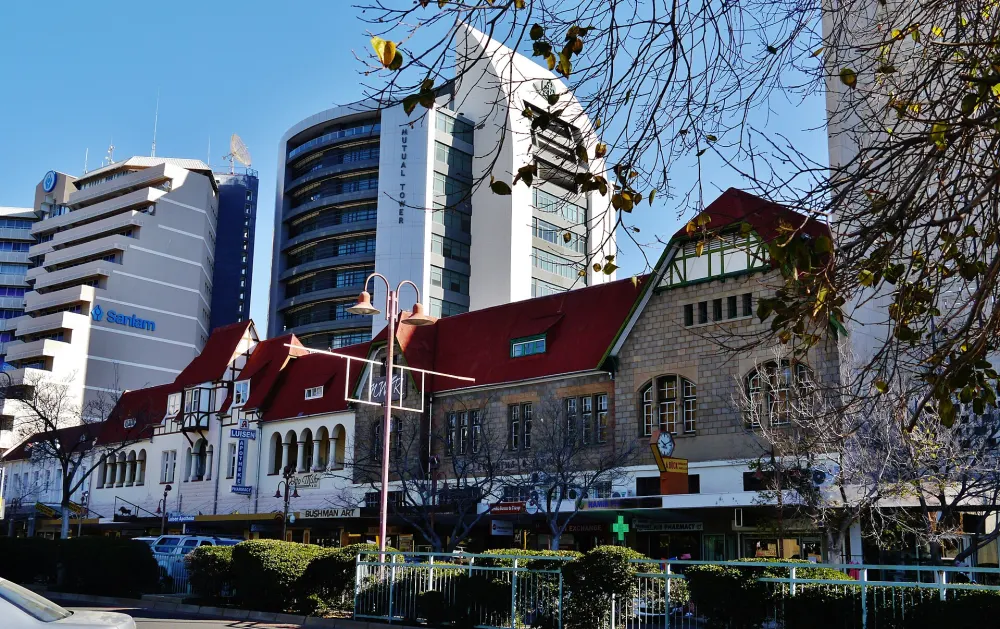
Violent crime against visitors is uncommon, and in rural Namibia almost unknown. The cautions concern Windhoek and, to a lesser degree, other towns. The UK Foreign Office reports that muggers target tourists in Windhoek, including in the city centre in daylight, and gives this advice:
- carry little, keep phones and cameras out of sight, and leave passports and spare cards in the hotel safe;
- do not hail taxis in the street; ask your accommodation to call a reputable company;
- keep car doors locked and windows up at intersections, and never leave anything visible in a parked car;
- do not leave a loaded vehicle unattended at fuel stations, where theft from cars is common;
- do not walk after dark, and do not enter townships at night unless with someone who knows the area;
- keep your card in sight when paying — card skimming has occurred at some hotels and lodges.
Carry photographic ID, since police checkpoints may ask for it, and keep a copy of your passport’s photo page separately. Do not photograph State House, military sites or other government security installations. Buying or carrying ivory, rhino horn or other parts of protected animals is a serious offence, as is possession of uncut diamonds.
Water and food
Tap water in Windhoek, Swakopmund and other towns is treated, and at lodges it usually comes from a borehole and is safe; ask on arrival, and drink bottled or filtered water where staff advise it or where the supply is a river. Carry your own drinking water on the road. Food hygiene in lodges and restaurants is generally good. Travellers’ diarrhoea is less common than in much of Africa; pack oral rehydration salts anyway.
Medical care, insurance and emergency numbers
Private hospitals in Windhoek offer a good standard of care, and there are private hospitals or clinics in Swakopmund, Walvis Bay, Otjiwarongo, Tsumeb and other large towns. State clinics exist in small settlements but have limited resources. Serious cases from remote areas are flown to Windhoek, and occasionally on to South Africa, by private air-ambulance services, which require proof of insurance or a guarantee of payment before they fly.
Take travel insurance that explicitly covers emergency medical evacuation by air, driving on gravel roads, and any activities you plan — quad biking, sandboarding, ballooning and skydiving are often excluded from basic policies. Carry the insurer’s 24-hour number in your wallet and in the car, and give your itinerary to someone at home.
- Police (national emergency line)
- 10111
- Ambulance and fire, Windhoek
- 061 211 111
- Elsewhere
- Call 10111 and ask for an ambulance, or the number your insurer or lodge provides
- Police Tourist Protection Unit, Windhoek
- +264 61 209 3111 (Independence Avenue)
- Country code
- +264 (drop the leading 0 of the area code)
A basic medical kit
- Any prescription medicines in original packaging, with a copy of the prescription, plus antimalarials if advised.
- Sunscreen, lip balm, rehydration salts.
- Insect repellent (DEET 50 % or icaridin) and antihistamine tablets or cream.
- Plasters, sterile dressings, a crepe bandage, antiseptic, tweezers, blister plasters.
- Painkillers, an anti-diarrhoeal and something for motion sickness if you are taking a boat cruise or a scenic flight.
- Spare glasses or contact lenses; the dust is hard on lenses.
Pharmacies in Windhoek and Swakopmund are well stocked. Beyond the towns there are none.
Frequently asked questions
Is Namibia safe for tourists?
Yes, by regional and global standards. Serious crime against visitors is uncommon outside parts of Windhoek, where ordinary city precautions apply. The main risks are road accidents on gravel, heat and dehydration, and malaria in the far north.
Do I need malaria tablets for Etosha?
It depends on the month and on whose guidance you follow. UK guidance rates the regions around Etosha as high risk from December to April, when tablets are advised, and low risk from May to November, when bite avoidance is advised. The US CDC recommends tablets for those regions without a seasonal distinction. Ask a travel clinic about your dates.
Is there malaria in Windhoek, Swakopmund or Sossusvlei?
The risk is very low in all three, and the CDC states there is no transmission in Windhoek. Official guidance recommends bite avoidance only, not tablets, for these areas.
Can you drink the tap water in Namibia?
In towns the water is treated and generally safe, and most lodges supply safe borehole water. Ask on arrival, and use bottled or filtered water where you are told to or where the source is a river.
What vaccinations do I need for Namibia?
None is compulsory unless you arrive from a yellow fever risk country. UK guidance advises hepatitis A, tetanus and typhoid for most travellers, with hepatitis B and rabies for some. Check that routine vaccines, including polio and measles, are current.
What is the emergency number in Namibia?
The police emergency line is 10111 nationwide. In Windhoek the municipal ambulance and fire service answers on 061 211 111. Lodges and rental companies also give guests their own emergency contacts, which are often the fastest route to help in remote areas.
Sources and official information
Facts were checked against these official sources in November 2026. Park fees, gate times, visa rules and timetables change, so confirm before you go.
NamibiaSafaris.com is an independent guide, not the official site of any tour operator, lodge, Namibia Wildlife Resorts or the Namibian government. Some links are affiliate links: tours go to GetYourGuide and accommodation goes to Booking.com, and we may earn a commission at no extra cost to you.